
EUACCIssue #15 · 17-24 Aug 2026
Europe's physical layer is funding up -- six rounds in semiconductor wafers, ocean robotics, aquaculture, femtosecond lasers, and industrial energy, and none in consumer AI.
🧠The Big Picture
Europe's Hardware Turn
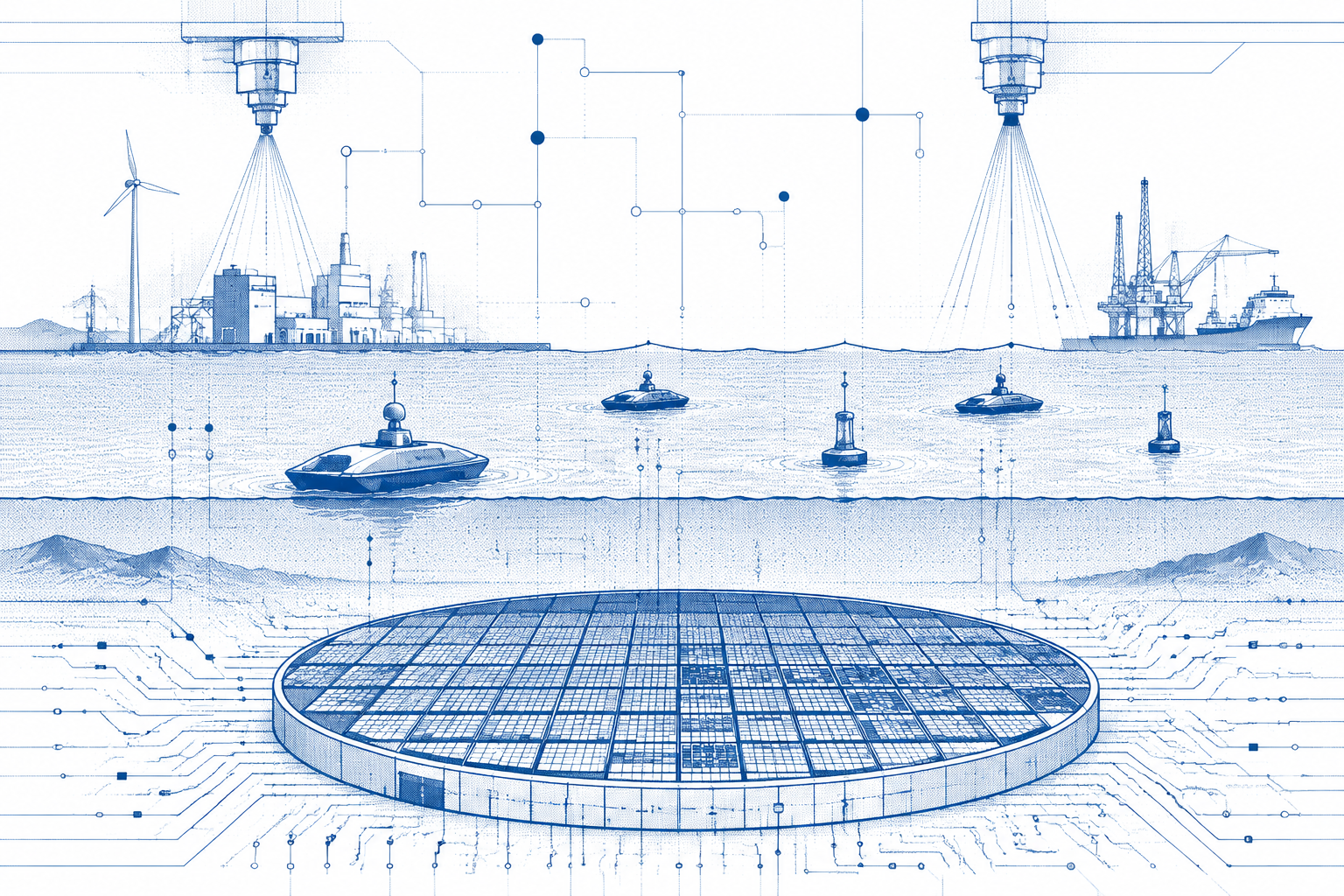
The EU AI Act's transparency and general-purpose AI rules came into force on 2 August. The week that followed told a story about where European capital goes when regulation reshapes incentives. Every significant round in Europe this week was physical: gallium nitride semiconductor wafers, land-based aquaculture, ocean robotics, femtosecond lasers, industrial electricity management. Six rounds, zero consumer AI.
The shift is structural, not accidental. Europe's regulatory environment imposes real costs on software-layer AI -- mandatory disclosures, prohibited use cases, ongoing conformity assessments -- while imposing none of those costs on companies that make materials, grow fish, or sense the ocean floor. European engineers hold genuine world-class advantages in precision manufacturing, photonics, and industrial systems that they do not hold in consumer AI applications. Capital follows comparative advantage, and the comparisons this week are unambiguous.
The deeper signal is in who is backing these rounds. Thisbe AB and North Ventures led SweGaN's semiconductor round; the European Investment Bank provided venture debt to Oceanloop; Encevo, a Luxembourg energy utility, led SnerpaPower's seed. Industrial corporates, development banks, and deep-tech specialists are setting the pace -- not consumer-app venture funds. This configuration matches what Europe built across the 20th century in manufacturing, materials, and energy infrastructure, and is now rebuilding in 21st-century form.
📋Grant World
The Closing Window
One deadline lands in three days.
⚠️ ERC Advanced Grants -- 27 Aug 2026 · Up to €2.5M over 5 years · For established researchers with 10+ year post-PhD track records; scientific directors of EU-registered companies qualify, not only academics. Fully non-dilutive. If you were planning to apply, the deadline is Thursday.
EIC Accelerator Batch 5 (full proposal) -- 2 Sep 2026 · Up to €2.5M grant + €17.5M equity · Full proposals only -- short applications are batched monthly with no deadline. If you received a short-application invitation, this batch is your next window.
EIC STEP Scale Up -- 9 Sep 2026 · EU equity co-investment catalysing rounds of €50M+ with investor pre-commitments · For growth-stage AI, deeptech, cleantech, digital, or biotech companies. Open to EU, EEA, and UK companies under 500 employees. Third of four 2026 windows.
MSCA Postdoctoral Fellowships -- 9 Sep 2026 · Up to €175,000 per researcher placement · EU-registered companies can host a PhD-level researcher for 12-24 months, fully subsidised. Often missed by startups: this is not a research grant -- it is free senior engineering labour.
Clean energy / decarbonisation call -- 15 Sep 2026 · €125M total budget · Market deployment of clean technologies for energy-intensive industries. SMEs eligible; not R&D-only.
ERC Proof of Concept -- 17 Sep 2026 · Up to €150,000 · For existing ERC grant holders exploring the commercial applications of funded research.
💶Who Got Funded
Hardware All the Way Down
Oceanloop -- Munich, Germany · €38.5M · Blue economy / land-based aquaculture · Hatch Blue/Blue Revolution Fund (lead), Stolt Ventures + EIB venture debt
The EIB's venture debt facility anchors a round building Giant Grouper farms in Kiel and Gran Canaria. Land-based recirculating aquaculture is Europe's answer to the protein sovereignty question: no fishing quotas, no weather dependency, consistent supply to European markets.
SweGaN -- Linköping, Sweden · €12.1M ($14M) · Series B · Semiconductor materials / defence-adjacent · Thisbe AB (lead), North Ventures
GaN-on-SiC wafers are the key substrate for power electronics in military radar, 5G base stations, and EV fast-charging. SweGaN is one of a handful of European producers; total funding now $41M, with capacity expansion against confirmed customer demand.
LITILIT -- Vilnius, Lithuania · €8M · Development loan · Photonics / industrial lasers · ILTE (Lithuanian National Development Bank)
The loan funds FEMODA, a modular femtosecond laser targeting 1,000W average optical power for automotive and aerospace factories. Total project cost: €10M. A new factory in Vilnius begins operations this autumn; commercialisation target is 2029.
Oshen -- Plymouth, UK · €4.27M · Seed · Ocean robotics / maritime intelligence · Lunar Ventures (lead), AlbionVC, Twin Track, Concept Ventures
Oshen's C-Star robots -- 1.2m, wind-and-solar-powered, deployable by one person -- sail for months without maintenance and transmit in constellation. Navies and weather agencies are the primary customers; workforce has tripled to 30 since last September.
SnerpaPower -- Reykjavik, Iceland · €3.4M · Seed · Industrial energy management · Encevo (lead), Crowberry Capital, BackingMinds + Icelandic Technology Development Fund grant
Manages more than 10 TWh of annual industrial electricity consumption. Encevo, a Luxembourg-based energy transition utility, leading is a strategic signal: utilities are buying into software that cuts their industrial clients' bills.
Cytix -- Manchester, UK · €6M · Series A · Cybersecurity (AI-driven software risk) · Northern Gritstone (lead), Auriga Cyber Ventures, NPIF II-PXN Equity Finance
Change risk management for enterprises navigating rapid AI-driven software deployment. Northern Gritstone -- the deep-tech fund backed by Manchester and Sheffield universities -- led the round, its fourth UK cybersecurity bet this year.
Pattern read: Five of six rounds touch physical infrastructure, sovereign resources, or critical materials. The geography is reshuffling too: Vilnius, Reykjavik, and Plymouth join Munich and Linköping. European deep-tech is not a German story this week -- it is a continental one.
📈Where EU Money Is Flowing
Three Structural Shifts
Development banks are becoming venture co-investors. The EIB's venture debt in Oceanloop's round, ILTE's development loan to LITILIT, and Encevo's strategic seed in SnerpaPower reflect the same structural move: national and European development institutions are writing equity-adjacent cheques directly into growth-stage companies, not just guaranteeing bank debt. The line between public development finance and private venture capital is dissolving, and it matters because these institutions can hold illiquid positions for a decade that private funds cannot.
European semiconductor sovereignty is attracting private capital. SweGaN's Series B is the latest in a string of European semiconductor materials rounds since the 2022 Chips Act. GaN-on-SiC matters to defence radar, 5G base stations, and EV power electronics -- sectors where Europe has strategic reasons to avoid Asian supply-chain dependence. The market is niche enough that European producers can achieve quality leadership; regulatory demand is large enough that customers pay a premium for it.
Ocean and food-system capital is concentrating in northern Europe. Oceanloop, Oshen, and SnerpaPower all address systems under climate and geopolitical stress -- fisheries, maritime surveillance, industrial electricity -- in regions with genuine technical infrastructure to solve them. Specialist vehicles like Hatch Blue's Blue Revolution Fund and Lunar Ventures are leading these rounds: patient capital with deep domain expertise, exactly the configuration that scales companies where returns take a decade.
💡One Move
Get Into the EIC STEP Scale Up Before September 9
The EIC STEP Scale Up closes 9 September 2026 -- sixteen days from today. Most founders at growth stage have not read the eligibility criteria, and the gap between eligible and applying is almost entirely one of awareness.
STEP Scale Up is not a grant. It is EU equity co-investment, written in alongside committed private investors, to catalyse rounds of €50 million or above. If you have investor pre-commitments and a round architecture that can absorb an institutional EU equity ticket, you are likely eligible. Sectors: AI, deeptech, cleantech, digital infrastructure, biotech. Eligibility: EU, EEA, and UK companies under 500 employees. Apply through the EIC Portal; evaluation results arrive in early 2027.
The September 9 window is the third of four in 2026. The next is 25 November. If your round closes before then -- and rounds do -- September 9 is the one that matters.
Get it every Monday
Free · 5 min read · Unsubscribe anytime
← All 22 issuesEUACC · Get funded. Build Europe.