Loading page...

Log inCreate account
Loading page...
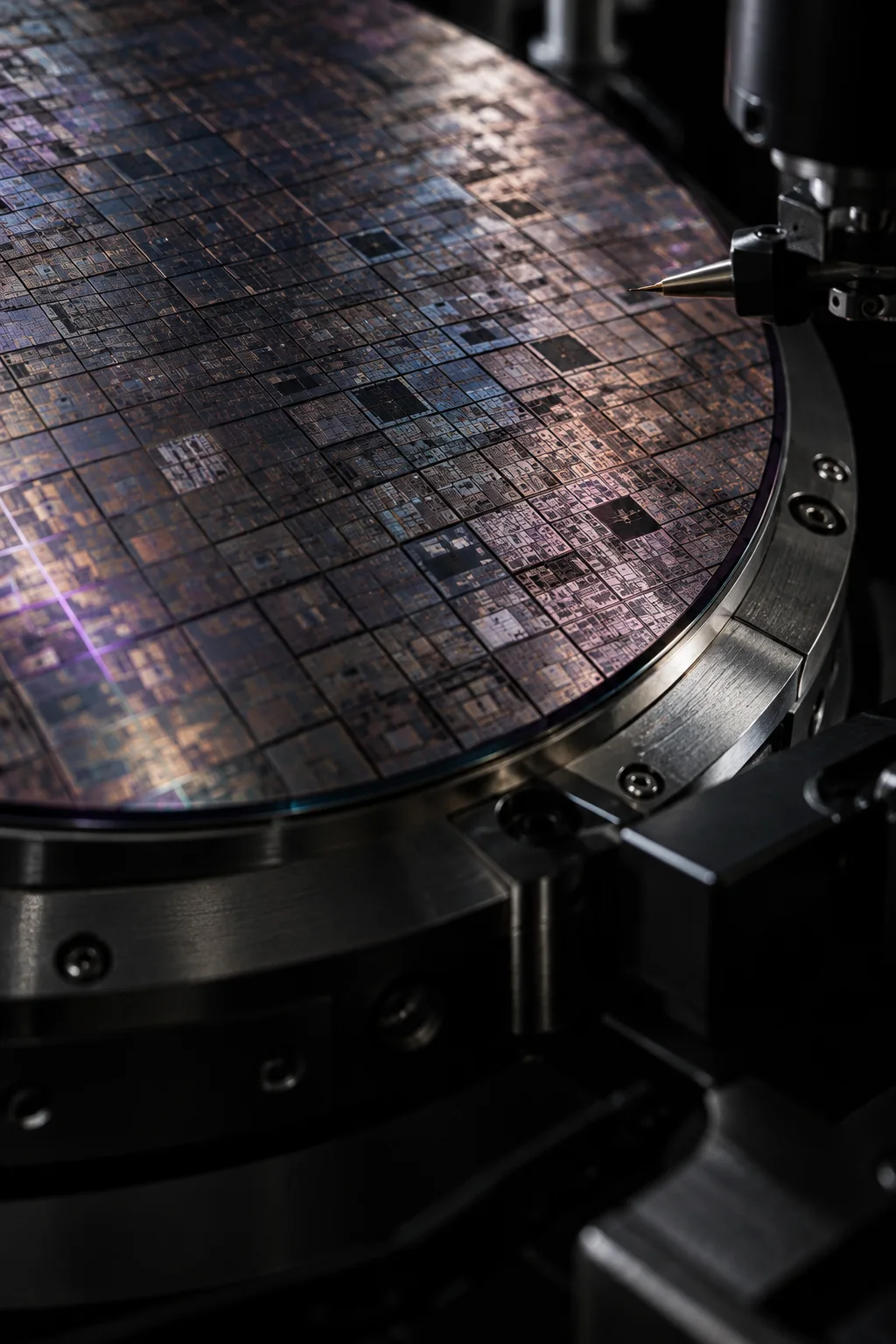
Grant size depends on the topic
AI demonstrators expect about €1M per project; the €70M platform is a separate procurement action.Semiconductor R&D, design and shared infrastructure, with topic-specific grants and national co-funding
AI-generated cover illustration. Programme details are sourced separately below.
Recorded editorial check · 23 days ago (3 Oct 2026)
Chips JU funds semiconductor research and capacity-building through the Electronic Components and Systems programme and the Chips for Europe Initiative. Routes include collaborative R&D, design support, pilot lines, competence centres and Digital Europe infrastructure actions. Application rules differ between these routes: use the exact Horizon Europe or Digital Europe topic, its applicant guide and any participating-state funding conditions. The current AI demonstrator, compute-platform and EU–Japan calls must not be presented as a single standard grant size or funding rate.
The numbers are sobering, even if the Chips JU does not publish a headline success rate the way the EIC does.
The hidden gate: your country must not only be a Participating State — it must have national budget left for that year's call, and you must pass its separate national eligibility rules. Phone your National Funding Authority before writing a word.
Five open-access pilot lines let companies prototype and validate advanced chips without building their own fab. NanoIC at imec (Leuven) pushes sub-2nm logic and is the largest at a combined €2.5bn (€700m EU, €700m national, the rest from ASML and industry partners). APECS, coordinated by Fraunhofer in Germany, handles advanced packaging and chiplets; FAMES (CEA-Leti, France) covers FD-SOI and emerging memory.
Open-access prototyping and small-volume manufacturing on cutting-edge process technology
A dedicated pilot line for advanced photonic integrated circuits, coordinated by ICFO in Barcelona with partners across eleven European countries. It offers cutting-edge platforms to move integrated-photonics processes from lab to industrial adoption.
Photonic chip prototyping and process transfer to industry
Focused on wide-band-gap semiconductor materials such as silicon carbide and gallium nitride, used in power electronics and radio-frequency applications.
Research and prototyping on SiC and GaN power and RF devices
A pan-European, cloud-based design platform coordinated by imec that gives SMEs, start-ups and fabless firms access to commercial EDA tools, IP libraries and a route to the pilot lines. Onboarding first companies 2026–2028.
Subsidised EDA-tool access, IP libraries and route-to-chip for fabless designers
A network of national Chips Competence Centres established across all 27 EU member states (plus Norway) to give local industry, SMEs and researchers a single front door to skills, design support and pilot-line access.
Local training, expertise and signposting to Chips JU infrastructure
Annual collaborative calls in Electronic Components and Systems (ECS) fund consortia from low to high technology-readiness via Research and Innovation Actions (RIA) and Innovation Actions (IA). A 'Global' strand opens topics to international cooperation. EU money is matched by participating-state co-funding, so national eligibility rules apply.
Multi-partner R&D consortia in chips and electronic systems, co-funded by member states
This describes the stated cohort and evaluation stage, rather than the outcome of a future application.
| Call / topic | Submitted | Selected | Success rate |
|---|---|---|---|
| Global IA (2024-1, bottom-up) | 13 | 5 | 38% |
| IA focus topics (RISC-V, SDV) | 2 | 2 | 100% |
| Global RIA (2024-2, bottom-up) | 22 | 3 | 14% |
| RIA focus topic (greener manufacturing) | 1 | 1 | 100% |
| EU-Korea joint RIA (2024-3) | 15 | 4 | 27% |
| Total ECS calls 2024 | 53 | 15 | 28% |
The 2024 annual report flagged that success rates dropped vs 2023, blaming smaller budgets for open bottom-up topics — focus topics drew one or two bids each and sailed through. Two-stage calls gate hard: only proposals passing the Project Outline may submit a Full Project Proposal, and grant signature comes roughly 8 months after the final deadline. The 2025 Annual Activity Report (published July 2026) covers all 19 Chips JU calls: 84 proposals submitted, 29 funded (~35% overall) — ECS call-by-call breakdown comparable to the table above is not separately published.
Most 2026 ECS (Electronic Components and Systems) calls are co-funded with National Funding Authorities (NFAs): the Chips JU pays the EU share, your own Participating State pays the national share under its own rules. The work programme carries a country-by-country annex of national eligibility criteria, and several states demand a parallel national application — Austria, for instance, requires Austrian partners to file electronically via the FFG eCall system before the deadline. Winning the European evaluation does not guarantee national money; partners ruled ineligible by their NFA can hole an otherwise funded consortium below the waterline.
Participation in the 2026 global calls is limited to legal entities established in EU member states (including overseas countries and territories), the EEA (European Economic Area: Iceland, Liechtenstein, Norway), Horizon Europe associated countries, and OECD and Mercosur countries. UK and Swiss entities clear the EU-level test (both are OECD members, and the UK is Horizon-associated). The catch is the money: national co-funding flows only through the NFAs of Chips JU Participating States, so check whether your national authority actually funds this call before budgeting around it.
In the bottom-up global IA (Innovation Action) and RIA (Research and Innovation Action) calls, no single partner may take more than 30% of the total EU funding requested. The work programme is blunt: proposals that do not comply "will be excluded" — they never reach the evaluators. A dominant coordinator who hoovers up the budget disqualifies everyone.
An entity established in an eligible country but directly or indirectly controlled from a non-eligible country (or by a non-eligible-country entity) may not participate unless it provides guarantees approved by its member state or associated country of establishment, demonstrating that the project's results, IP (intellectual property) and sensitive information stay out of non-eligible hands. Guarantees are submitted after proposal selection — so a foreign-owned subsidiary can pass evaluation and still fall at grant preparation. Entities assessed as high-risk suppliers of mobile-network equipment (or anything they fully or partially own or control) cannot submit guarantees at all.
All beneficiaries face a financial-capacity check during grant preparation — balance sheet, profit-and-loss account, audited accounts for the last closed financial year — except public bodies and participants requesting no more than €60,000. A weak balance sheet (the analysis also weighs dependency on EU funding and prior-year deficits) can trigger pre-financing in instalments, bank guarantees, joint-and-several liability, zero pre-financing, forced replacement of the partner, or rejection of the entire proposal. Young, loss-making startups should budget for this conversation.
Natural persons are ineligible (sole traders without separate legal personality excepted). International organisations are out unless they qualify as being "of European interest". EU bodies cannot join the consortium (the Commission's Joint Research Centre excepted). Entities under EU restrictive measures are barred in any capacity — including as subcontractors — as are Hungarian public-interest trusts under the EU's rule-of-law conditionality decision. Every beneficiary and affiliated entity must be registered and validated in the Participant Register before submission.
The current AI and Japan topics link ownership-control declarations and security restrictions. Check every partner and subcontracting role against the current general annexes before committing the consortium.
ECS research rates are not a universal Chips JU rate. The current Digital Europe topics have separate action types and applicant guides, including national budget information.
Your project should sit at TRL 3–8 when you apply. The eligible band is highlighted below.
Chips JU is a tripartite partnership: the EU (through the Joint Undertaking), the Participating States, and the participants themselves. That means you apply twice — once on the EU Funding & Tenders Portal, once to your national funding authority (in Austria via the FFG eCall, in Denmark via e-grant) — and if you win, you sign two separate grant agreements. The proposal even carries a special 'National Budgets Table' and password-protected national annexes per country.
Each country publishes its own pot per topic — Austria's 2025 allocation was €3.0M for the global IA (Innovation Action) topic and €3.6M for the global RIA (Research and Innovation Action) — plus its own rules (Austria demands a 1.5:1 person-month ratio of companies to research organisations; other states require an SME or an academic partner in the consortium). A top EU evaluation score does not conjure national money: if your country's pot is empty or you fail national eligibility, you sit in the project under-funded. In some countries costs only become eligible from the day the national contract is signed.
On the EU side, a large enterprise gets 20% of costs in an IA and 25% in a RIA; an SME gets 30% and 35%; research organisations and other non-profits get 35%. The national grant adds on average another 26–31%, leaving roughly 40–48% of project costs as your own investment. One exception proved the rule: the 2024 EU–Korea joint call was 100% EU-funded with no national leg.
The Funding & Tenders Portal does not implement Chips JU's bespoke funding rates for large enterprises — applicants must compute their requested EU contribution outside the system and type the figure in manually. After signature, all payments (prefinancing, interim, balance) flow to the coordinator, who redistributes under the consortium agreement.
The ECS historical co-funding examples above must not be applied automatically to Digital Europe actions.
Choose the exact open topic in the Chips JU register. The AI demonstrator and compute-platform calls close 27 October 2026; EU–Japan closes 8 December. All three are Digital Europe single-stage actions; use the individual guide and its national budget rules.
For a future two-stage topic, a project outline must pass before a full proposal is invited. The three currently listed Digital Europe calls use one full-proposal submission. Do not assume a stage or deadline for an unannounced future quantum call.
For the Digital Europe Programme calls now open: DIGITAL-JU-CHIPS-2026-AI1-SG (€10M) and DIGITAL-JU-CHIPS-2026-AI-GfP (€70M) both have a 27 October 2026 deadline; DIGITAL-JU-Chips-2026-SG-JAPAN (€3-5M) closes 8 December 2026. All three are single-stage — submit the full proposal through the Digital Europe programme portal (not the Horizon portal). For historical reference: the 2026 ECS coordination CSAs closed 22 September 2026; the HORIZON-JU two-stage Global call Phase 2 closed 17 September 2026; the ECS Resilience FT1-FT3 and 6G RIA calls closed 16 September 2026. Independent experts score proposals against Excellence, Impact, and Quality and Efficiency of Implementation — each 0-5, 3/5 threshold.
For ECS bi-partite calls, ranking by Chips JU experts is necessary but not sufficient: each national funding authority of every Participating State makes its own formal co-financing decision for its own beneficiaries, against national rules and budgets. The Chips JU collects these decisions and relays the consolidated result to consortium coordinators. For the 2026 calls, this is expected in early 2027. Global IA/RIA and Chips for Europe DIGITAL calls skip this step entirely — funding comes wholly from the Chips JU or the DIGITAL programme.
Successful proposals enter Grant Agreement Preparation on the Funding and Tenders Portal: legal and financial validation of each beneficiary, finalised budgets, and the description of action. The Chips JU signs the EU grant; for bi-partite ECS projects national authorities additionally contract their own beneficiaries under national agreements. Standard Horizon Europe time-to-grant targets apply.
Scientific and technological soundness and ambition of the concept, the credibility of the proposed approach against the targeted Work Programme challenge/topic, and the appropriateness of the TRL focus (centre of gravity TRL 3-4 for RIA, higher TRL 5-8 for market-oriented IA). Scored 0-5 with half-marks.
Contribution to European semiconductor sovereignty, supply-chain resilience and industrial competitiveness; for IA projects a credible deployment/exploitation plan ensuring economic value creation in Europe and a clear roadmap beyond the project. Scored 0-5 with half-marks.
Coherence of the work plan, allocation of resources and budget, and the quality and complementarity of the consortium (transnational, academia plus industry; significant business participation for IA). Assessed only at the second stage once the full proposal and detailed costs are submitted. Scored 0-5 with half-marks.
Current topic register with opening dates, deadlines and EU envelopes.
General annexes, 2026 ECS Appendix 7 and Chips for Europe Appendix 8; use current versions.
€10M topic envelope, expected EU contribution about €1M/project; deadline 27 October 2026. The page links the applicant guide, application/evaluation forms, national budget table and ownership declaration.
€70M grant-for-procurement topic; expected contribution about €70M to the platform project; deadline 27 October 2026.
€5M EU envelope; expected €3–5M/project; deadline 8 December 2026. Chiplets and advanced process collaboration with Japan.
Call-specific proposal instructions; accessed through Chips JU’s document-link service.
Application form linked from the official AI demonstrator topic.
Evaluation form linked from the official AI demonstrator topic.
AI demonstrators, compute platform and EU–Japan semiconductor collaboration.
Two separate actions: €10M and €70M topic envelopes.
€5M EU envelope; confirm national co-funding and joint participation requirements.
Do not apply the Horizon Europe schedule automatically to a Digital Europe action.
Winners sign the Chips JU Model Grant Agreement — published with the call documents and explicitly non-negotiable — plus separate national grants or contracts with each partner's funding authority. The JU and the national agencies try to synchronise the two processes during grant preparation, but the burden of running both in parallel sits with the consortium.
Payments follow Horizon Europe rules: prefinancing, interim payments and the final balance are all transferred to the project coordinator, who redistributes to beneficiaries under the consortium agreement — which must be concluded before the EU grant is signed. National money arrives on each country's own schedule and conditions.
Evaluation results come within 5 months of the deadline (Horizon standard); the indicative grant signature is 8 months after the Full Project Proposal deadline. For a two-stage call opening in February with a May outline and September full proposal, real work funded by the EU grant typically starts well into the following year.
The no-profit rule is checked at project end, double funding from the EU budget is strictly prohibited, and beneficiary names, addresses and maximum awarded amounts are published annually on the Europa website. Expect periodic reporting and deliverables to a Chips JU project officer, with national reporting on top.
A self-declared SME (small or medium-sized enterprise) rating is enough to submit, but at grant preparation the organisation's LEAR (Legal Entity Appointed Representative) must complete the formal SME self-assessment. Fail it — or skip it — and your funding rate drops to the large-enterprise level.
Chips JU ECS calls are co-funded: the JU pays part and your own country's National Funding Authority pays the rest, so being scored well by Brussels is not enough — you must also be eligible under your national rules, which differ by country and can require an SME or a specific industry/academic mix in the consortium. Contact your National Funding Authority (listed in the Annual Work Programme) the moment a call opens, because national funding can be capped or tied to the EU amount, and a partner deemed nationally ineligible can sink an otherwise-fundable proposal.
The ECS R&I calls are built by the community around AENEAS, EPoSS and Inside (the three industry associations that also write the ECS-SRIA roadmap the calls are based on). Their annual ECS Brokerage Event (next edition: 17–18 Feb 2027, Brussels; the 2026 edition drew 700+ participants) is where project ideas get pitched and consortia assembled — and even if you miss the pitch slots you can upload your idea to the ECS Collaboration Tool (ecscollaborationtool.eu) to find partners ahead of the next call.
The 2026 Global IA and Global RIA calls ran in two phases: a Project Outline (deadline 7 May 2026, now closed) then a Full Project Proposal for qualifying teams (deadline 17 September 2026, now closed). No 2027 Chips JU R&I calls have been announced yet; watch the official Open Calls page (chips-ju.europa.eu) for new timelines. When a future two-stage call opens, use the outline stage as the low-cost gate — it filters out weak ideas before you spend weeks on the full submission, and gives time to finalise the consortium and national funding paperwork.
Each country's National Contact Point for the Chips JU (e.g. NCP Flanders) gives free guidance on call rules, eligibility and proposal navigation — use them alongside your National Funding Authority. Separately, the network of Chips Competence Centres set up under the Chips Act offers free access to technical expertise, pilot lines, design platforms, training and even investor-finding support, which can strengthen the technical credibility of a proposal.
Live from the EU Funding & Tenders Portal.
Europe's largest Chips Act pilot line, at imec in Leuven, pushing sub-2nm logic with ASML and partners and giving companies open access to leading-edge nodes.
A Fraunhofer-coordinated pilot line for advanced packaging and chiplet integration, building Europe's capacity in heterogeneous integration.
An ICFO-led photonics pilot line spanning eleven countries that moves integrated-photonics processes from lab to industrial adoption.
An Infineon-coordinated RIA developing next-generation electronic components for automated systems across automotive, aerospace and industrial use.
Sixty partners across thirteen countries, led by Infineon, advancing materials, processes and equipment for electronics packaging.
No. The European Chips Act is the wider EU regulation and strategy. The Chips JU runs its funding arm — the Chips for Europe Initiative — which pays for R&D, pilot lines, a chip design platform, competence centres and skills, with up to €3.3B of EU money (€1.65B Horizon Europe + €1.65B Digital Europe).
Rarely. Most Chips JU calls require a consortium of partners from several participating countries. If you want non-dilutive funding for one company, the EIC Accelerator is the better route.
Funding depends on the topic, action type, organisation and participating-state rules. The ECS co-funding percentages do not automatically apply to the current Digital Europe topics. Use the call-specific applicant guide and confirm national funding before submission.
Some topics combine a Chips JU contribution with separate national funding. Check the exact topic’s mode and each partner’s national authority; an EU ranking does not remove national eligibility or budget limits.
Pilot lines (e.g. PIXEurope for photonics, the Wide Band Gap line, FAMES) are shared advanced-manufacturing facilities where companies prototype chips they could not build alone. Competence centres — 30 of them across 28 countries — give SMEs and researchers local access to chip-design expertise and tools.
The two AI infrastructure topics close on 27 October 2026; the EU–Japan topic closes on 8 December 2026. Future dates should be taken from the current Chips JU register and annual appendices; unconfirmed quantum dates are not treated as open application opportunities.
All Chips JU proposals are submitted via the EU Funding & Tenders Portal under the relevant HORIZON-JU-CHIPS or DIGITAL-JU-CHIPS call identifier. Two-stage calls require a short outline first, then a full proposal if invited.
Official-source review of current calls, decision facts, selected topic budgets, application artefacts and access restrictions. Existing rich material is preserved where not superseded; this is not a full re-verification of every historical statement. Follow-up reconciliation of normalized root metadata and the Cluster 4 hero facts against this scoped research; unsupported generic numeric ranges and totals are intentionally null.
Research updated: 2026-10-12
Official call documents take precedence. A listed reference is not necessarily indexed in full by the AI.
Read the complete text reference → Grant
GrantTopic-specific project grants
View programme → Blended
Grant below €2.5M + up to €10M equity
View programme → Grant
GrantTopic-specific grants
View programme → Platform / Seal
€10M–30M equity per company
View programme → Grant
GrantUp to €2.5M
View programme →Choose your AI and follow the walkthrough. Your free EUACC account connects the two.
Illustrated walkthrough
https://www.euacc.ai/api/mcpWorks on every Claude plan, including Free (one custom connector). On Team and Enterprise, an Owner adds it.
On a phone, add it at claude.ai in your browser. It then shows up in the Claude app the next time you sign in.
Use EUACC to explore “Chips ju” (https://www.euacc.ai/programmes/chips-ju). Does this programme fit my startup, and what should I check before applying? Cite the available sources and flag missing or outdated information.