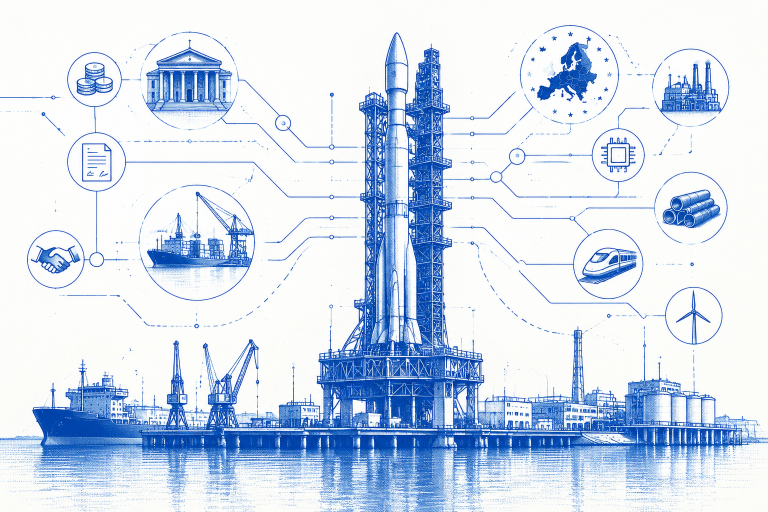
ESA's procurement blueprint triggers private equity follow-through, the €5B Scaleup Fund is about to write its first cheques, and the industrial decarbonisation call closes in eight days.
ESA's Procurement Cheque Unlocks the Private Round
The week began with a direct consequence of an announcement made ten days earlier. On 27 August, the European Space Agency awarded its first European Launcher Challenge contracts: €158.9 million to PLD Space, with additional contracts totalling €543.6 million split across Isar Aerospace and Rocket Factory Augsburg — the first time a European institution has backed three private launch companies simultaneously through performance-based procurement rather than grants. By 1 September, PLD Space had returned to market with a fresh equity ask.
The extension worked. PLD Space added €108 million to its Series C, bringing the round to €288 million and aggregate funding to €488 million. Mitsubishi Electric led; COFIDES (Spain's state development finance institution), Endeavor Catalyst, and the Spain Oman Private Equity Fund co-invested. The sequencing is deliberate: the ESA contract — a performance-based service contract, not a grant — functioned as a credit signal to private investors. Mitsubishi's equity stake signals a supply-chain alignment in motion; they both make satellite components and need launch services.
The structural read: European aerospace has no shortage of seed capital. The problem has always been the industrial scaling phase — where you need factory floor investment, a committed launch manifest, and revenue before a private equity investor will write a large cheque. ESA's European Launcher Challenge addresses exactly that gap with procurement rather than subsidy. If the template holds — public contract first, private equity follows — it will replicate into clean hydrogen, advanced manufacturing, and industrial biotech. Public procurement as the de-risking mechanism for private growth capital is the pattern to watch across EU industrial policy in 2026.
Grant World
Eight Days to the Industrial Decarbonisation Call
One deadline is eight days away; three more cluster in October and November.
⚠️ Horizon Europe Clean Industrial Deal (HORIZON-CID-2026-01) · 15 September 2026 · Up to €25M per project · €275M total envelope · For demonstration-scale industrial pilot projects in energy-intensive sectors: steel, cement, chemicals, and glass. Consortium-based: 5–10 partners, at least three independent legal entities from different EU member states. This is not the EIC Accelerator — it targets organisations already running pilot plants that need funding to prove viability at near-commercial scale. Submit through the EU Funding and Tenders Portal; managing body is HaDEA.
EIC STEP Scale Up — Defence · 28 October 2026 · EU direct equity co-investment up to €30M per company · For EU, EEA, and UK companies in defence or dual-use technology. Equity at the cap table alongside private investors; introduced in the updated EIC Fund Investment Guidelines published 27 August. Applications remain open.
EIC Pathfinder Challenges · 28 October 2026 · Up to €4M per project · For research consortia at TRL 1–3. The 2026 challenges include quantum sensing, materials for extreme environments, and synthetic biology for industrial processes. Better entry point for deep tech that needs another research cycle before pilot scale.
EIC Accelerator Batch 6 — full proposals · 4 November 2026 · Up to €2.5M grant + €17.5M equity · For companies holding a short-application invitation. If you received one, 4 November is your window. No invitation means no access this batch.
Who Got Funded
Rockets, Batteries, and Belgian BESS
PLD Space — Elche, Spain · €108M (Series C extension; total round €288M, aggregate funding €488M including €158.9M ESA contract) · Series C · Space launch · Mitsubishi Electric (lead), COFIDES, Endeavor Catalyst, Spain Oman Private Equity Fund. The ESA contract came first; private equity followed within days. The sequencing matters more than the amount.
Nexeon — Oxfordshire, UK · €116.7M · Late stage · Silicon anode battery materials · National Wealth Fund (lead, €61.4M), Korea Development Bank, Honda Xcelerator Ventures. The UK's sovereign wealth vehicle backing domestic battery supply chain; Honda's equity stake signals an offtake or supply conversation happening in parallel — they need what Nexeon makes.
Cloover — Berlin, Germany · €86.2M facility · Growth · AI-native energy platform (solar, heat pumps, home electrification) · EIF guarantee (€350M anchor), MMC Ventures, QED Investors (equity). Profitable three years in, revenue run rate >€301.7M. The EIF guarantee converts €18.8M in equity into €86.2M in deployment capacity — the leverage ratio is the story, not the absolute number.
Octave.energy — Mechelen, Belgium · €10M · Series A · Battery energy storage + energy management systems · SPDG Growth (Périer-D'Ieteren family office, lead), imec.istart, BNP Paribas Fortis, KBC. Profitable Belgian cleantech scaling BESS and EMS across European commercial real estate. No US or London lead.
Skylance — Hürth, Germany · >€1M seed · Seed · Counter-drone / defence tech · NRW.BANK (€500K anchor; the bank's first-ever defence investment). The NRW.BANK anchor matters beyond the size: German development banks are now writing cheques into defence tech — a sector they would not have touched before 2022.
Pattern read: Four of five rounds are in physical-world infrastructure — batteries, energy storage, energy management, space access. UK and Germany dominated. No consumer AI entered the top tier. Industrial electrification, space sovereignty, and defence resilience are where European institutional capital is actively deploying.
Where EU Money Is Flowing
Three Structural Shifts
Public procurement is becoming Europe's growth-stage instrument. ESA's European Launcher Challenge template — a performance-based contract that reduces commercial risk enough for private investors to follow immediately — could be the most important financing innovation in EU industrial policy since InvestEU. PLD Space demonstrated the sequence live this week: ESA anchor, then private equity. If the Commission replicates this in clean hydrogen, carbon capture, and advanced manufacturing, it changes how every deep-tech company at the industrial scaling phase should engage with public procurement calls. Watch the next round of Clean Industrial Deal contracts for evidence of the pattern.
European venture debt has crossed a threshold. Claret Capital's €575M Fund IV final close — 25% above the €500M target, €440M in fund commitments plus €135M in a discretionary mandate — shows that growth debt is now a mainstream component of the European startup financing stack. More than 90% of the LP base is public-institutional: the European Investment Fund, British Business Bank, KfW, and Ireland's ISIF. Governments are deliberately scaling non-dilutive debt as an alternative to equity for growth-stage companies. For founders at €5M+ ARR who do not want another round of dilution, the market is deeper than it was a year ago.
The Scaleup Europe Fund is moving from paper to portfolio. The €5B EQT-managed vehicle — €1B EU anchor from Horizon Europe, €200M EIFO lead LP commitment — is finalising its foundational legal agreements. First investments are expected in the coming weeks. When they arrive, they mark the first time European deep tech has a market-rate growth equity vehicle at scale that does not require founders to relocate or accept a down round. The structural sequence is now complete: EIC at seed, Scaleup Fund at growth, public procurement at industrial scale.
One Move
Submit to the Industrial Decarbonisation Call Before 15 September
The Horizon Europe Clean Industrial Deal call (HORIZON-CID-2026-01) closes on 15 September — eight days from today. The total budget is €275 million, structured as approximately eight projects at up to €25 million each. This is not a call most founders know about, because it does not target startups: it targets companies and consortia that already operate pilot-scale technology in energy-intensive industrial sectors and need EU funding to prove viability at near-commercial scale. Steel, cement, chemicals, glass. If that description fits, the window is now.
Eligibility requires a consortium of 5–10 partners, at least three independent legal entities from different EU member states, with SME participation encouraged. The managing body is the European Health and Digital Executive Agency (HaDEA); submit through the EU Funding and Tenders Portal under HORIZON-CID-2026-01. Results arrive in spring 2027 — time enough to line up matching private capital in parallel and have it ready when the grant decision lands.
If this call is too large or too late-stage for your current position, the next entry point is the EIC Pathfinder Challenges deadline of 28 October — up to €4M for research consortia at TRL 1–3, with no pilot-scale requirement. Two different rungs of the same ladder.
The weekly briefing
Funding calls, VC news and key deadlines. Free to read; unsubscribe anytime.