
EUACCIssue #05 · 8–15 Jun 2026
Europe can't win the chatbot war, so the smart money is betting it builds the robots instead.
🧠THE BIG PICTURE
Europe Found the AI Race It Can Win
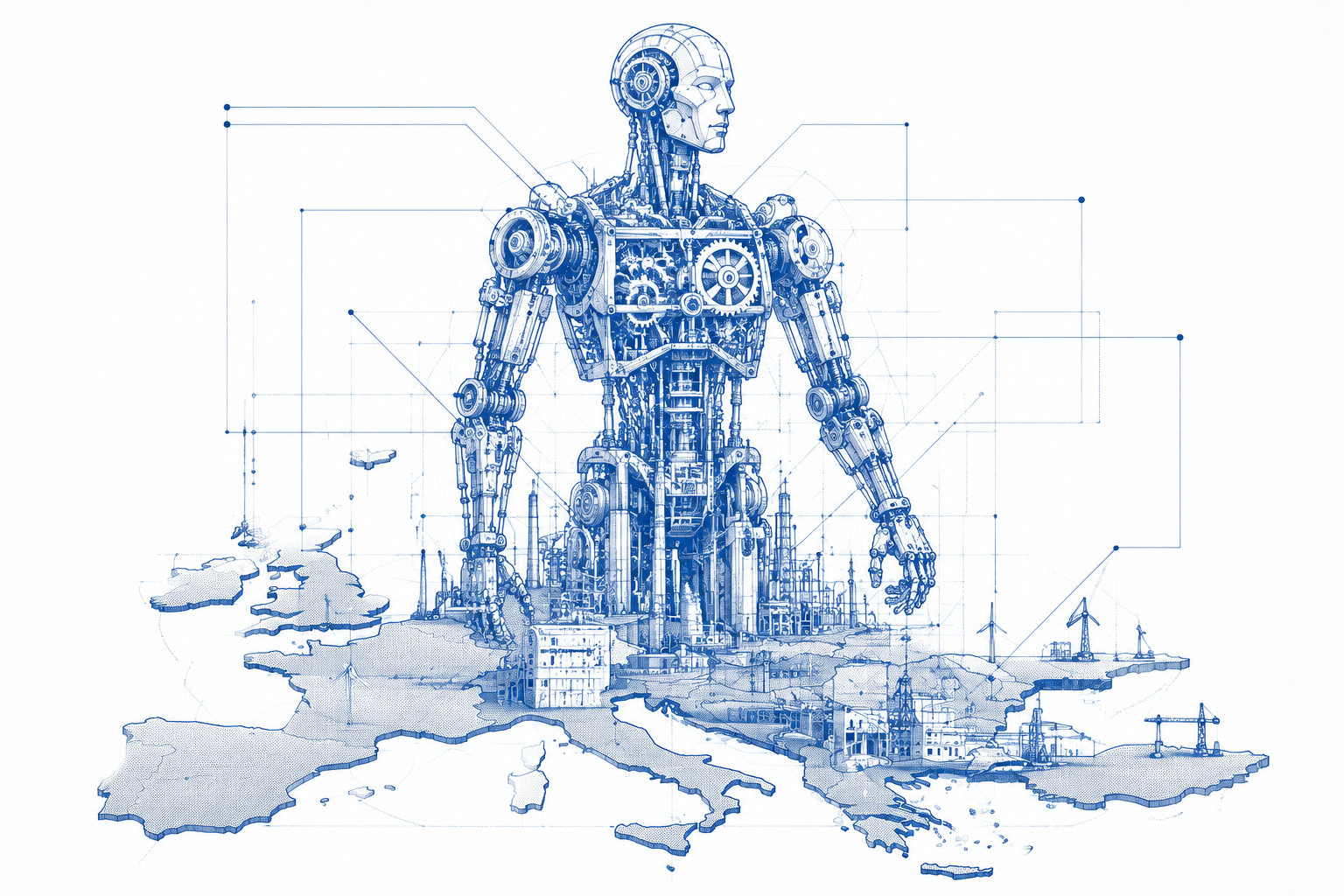
On June 10, NEURA Robotics — based in Metzingen, a town of 22,000 in Germany's industrial southwest — closed a Series C of up to $1.4 billion, the largest funding round ever raised by a full-stack robotics company. It values NEURA at roughly $7 billion and makes it, overnight, Europe's most-funded humanoid-robot maker. The cap table is the story: Tether led, alongside Nvidia, Qualcomm, Amazon, Bosch, Schaeffler, imec.xpand and the European Investment Bank. American and global capital isn't buying a European copy of a US robot. It's funding the European original.
A day earlier, on June 9, Google DeepMind unveiled the first cohort of its Accelerator: Robotics programme — 15 early-stage companies from Norway to Greece, gathered in London for a three-month, equity-free run on Gemini robotics models and DeepMind mentorship. Two of the most consequential robotics announcements of the year, in the same week, both pointing at Europe. That's not coincidence. It's positioning.
Europe has spent three years losing the AI race that runs on chatbots and frontier models — the one that needs hyperscale data centres, US chips, and American risk capital. Physical AI is a different race, and Europe starts it from the front. Four of the world's ten most robot-dense economies are European (Germany, Italy, France, Sweden); the continent owns the factory floors, the automotive supply chains, and the research benches — TU Munich, ETH Zürich, EPFL, IIT Genoa — where embodied AI gets trained and tested. A humanoid is only as good as the industrial substrate it plugs into, and that substrate is here.
The signal for founders: the money has decided where Europe's edge is. Robotics companies have raised $55.8 billion globally in 2026 (Dealroom), nearly double all of last year, and the European share is concentrating in physical AI, industrial automation, and the components — actuators, sensors, electronic skin — that humanoids need. If you're building software that talks, you're competing with OpenAI. If you're building intelligence that moves, lifts, or inspects, you're building in the one category where European industrial DNA is the moat.
📋GRANT WORLD
Women TechEU Reopens; the EIC Clock Restarts
The week's grant news landed on June 12, when the Commission reopened Women TechEU for 2026–2028: another €12 million, paid out as €75,000 equity-free cheques to 160 women-led deep-tech startups, plus mentoring and investor matchmaking. The eligibility window is already open, with weekly cut-offs every Tuesday from 30 June. For a founder who qualifies, it's the highest reward-to-effort grant in Europe right now.
Deadlines in the next ~8 weeks:
Women TechEU — first cut-off 30 Jun 2026 (~15 days) · €75K equity-free · women-led deep-tech (a woman as CEO/CTO holding ≥25%), EU/Associated, company 6 months–8 years old
EIC Accelerator Step 2 — 8 Jul 2026 (~23 days) · up to €2.5M grant + up to €10M equity · TRL 5–8 (Step 1 short proposals are continuously open, batched the first Tuesday of each month)
EIC Accelerator Step 2 — 2 Sep 2026 · the next full-proposal cut-off if you miss July
EIC STEP Scale-Up — 9 Sep 2026 · €10–30M equity for strategic-tech scale-ups (digital, clean, biotech) · needs a lead investor committed to ≥20% of a €50–150M round · €300M 2026 budget
Note the shape of the EIC's 2026 money: small and non-dilutive at the bottom (Women TechEU's €75K), blended grant-plus-equity in the middle (Accelerator), and pure growth equity at the top (STEP Scale-Up). If you're in robotics or another strategic technology, the September STEP window is the institutional cheque that matches the private money flooding the sector this week.
💶WHO GOT FUNDED
One Mega-Round, and the Application Layer Cleans Up
NEURA Robotics — Metzingen, Germany · up to $1.4B · Series C · physical AI / humanoid robotics · Tether (lead), Nvidia, Qualcomm, Amazon, Bosch, Schaeffler, imec.xpand, European Investment Bank
The largest round ever for a full-stack robotics company, at a ~$7B valuation. Bosch and Schaeffler on the cap table is the tell: Europe's industrial incumbents are buying into the humanoid before it ships.
Capsa AI — London, UK · $18M · Series A · AI for private capital · TX Ventures & Pivot Investment Partners (co-leads), Bek Ventures, Outward VC, Antler
Builds the "operating system" that turns a PE firm's scattered emails, documents and CRM data into one searchable layer. 14x year-on-year ARR growth and a 100% renewal rate explain the round.
Mendo — Paris, France · €12M · Series A · enterprise AI adoption · Ventech & Educapital (co-leads), Tomcat, OVNI
Sells the analytics layer that tells big companies which AI agents actually pay off; PwC, Novo Nordisk and Crédit Agricole already use it across ~100,000 employees. The pick-and-shovel play on the corporate AI rollout.
Uncovr — Paris, France · €6M ($7M) · Seed · surgical AI · Index Ventures (lead), Seedcamp, Frst, Entrepreneurs First
Turns operating-room video into the draft operative report and billing codes before the surgeon leaves the room — already piped into 400+ ORs across the US and Europe. Regulated-vertical AI with a clear workflow wedge.
Pattern read: strip out NEURA's mega-round and the week tells one story — European VC is funding the application layer, not the model layer. Capsa, Mendo and Uncovr all sell AI that does a specific, often regulated job (private-equity ops, enterprise adoption, surgical records), defensible because the data and the workflow are hard, not because the model is novel. And three of four rounds were co-led, not solo-bet: even in AI, European investors are still syndicating risk.
📈WHERE EU MONEY IS FLOWING
Physical AI, the Pick-and-Shovel Trade, and a Privatised State Fund
Physical AI is the new magnet. Robotics pulled in $55.8 billion globally in 2026 (Dealroom), nearly double 2025, and Europe is suddenly central to it — not as a customer, but as the place the robots get built. NEURA's $1.4B and DeepMind's robotics accelerator landed in the same week for the same reason: the continent's manufacturing density and component supply chains are the one asset US and Chinese rivals can't clone. Expect capital to keep moving down the stack — into actuators, sensors, and the unglamorous hardware humanoids run on.
The pick-and-shovel trade in AI. The breakout software rounds this week weren't foundation models; they were the tools that make AI usable inside an enterprise — Mendo's adoption analytics, Capsa's PE data layer, Uncovr's surgical records. With frontier models now a commodity, European VC is paying for the workflow, the compliance moat, and the proprietary data — exactly where Europe's regulated industries give local startups a head start.
The state is privatising its own venture arm. Two weeks ago the Commission handed its new €5 billion Scaleup Europe Fund — the largest of its kind on the continent — to EQT in Stockholm to manage, with first cheques due in autumn 2026. This week the European Investment Bank showed up directly in NEURA's $1.4B round. The pattern: rather than build state capacity to write growth cheques, Europe is wiring public money into private managers and private rounds. It's a quiet admission that the bottleneck was never the capital — it was who deploys it.
💡ONE MOVE
If You Qualify, File Women TechEU Before June 30
The single most time-sensitive action this week is narrow but high-value: if your deep-tech startup has a woman as CEO or CTO holding at least 25% of shares, is registered in the EU or a Horizon Europe Associated Country, and is between six months and eight years old, file for Women TechEU before the first cut-off on 30 June. The reward is €75,000 in equity-free cash plus mentoring and direct investor matchmaking — and unlike the EIC Accelerator's ~10% hit rate, this programme funds 160 companies a year, so the odds are real. The application is light, and the cut-offs run weekly, so a near-miss this round simply rolls to the next.
And keep one eye on the bigger money forming behind it. The €5B Scaleup Europe Fund (EQT) starts writing cheques this autumn, the EIC's STEP Scale-Up window reopens on 9 September, and — as this week proved — global capital is now actively hunting European physical-AI and industrial scale-ups. The €75K grant isn't the prize; it's the on-ramp to a capital stack that, for the first time in a decade, is being built to keep European companies in Europe.
Get it every Monday
Free · 5 min read · Unsubscribe anytime
← All 18 issuesEUACC · Get funded. Build Europe.